
When searching for a property in Gandhinagar, one of the first things buyers usually compare is the size of the home. But property sizes can be confusing because builders and sellers may mention carpet area, built-up area, or super built-up area.
For example, a flat may be advertised as 150 square yards, but that does not necessarily mean you have 150 square yards of usable living space inside the home.
This is why understanding carpet area vs built-up area is important before comparing flats, negotiating prices, or booking a property in Gandhinagar.
In this guide, we'll explain the difference using square yards (sq. yd.), with simple examples to help you understand exactly what you're paying for.
Quick Answer: Carpet Area vs Built-Up Area
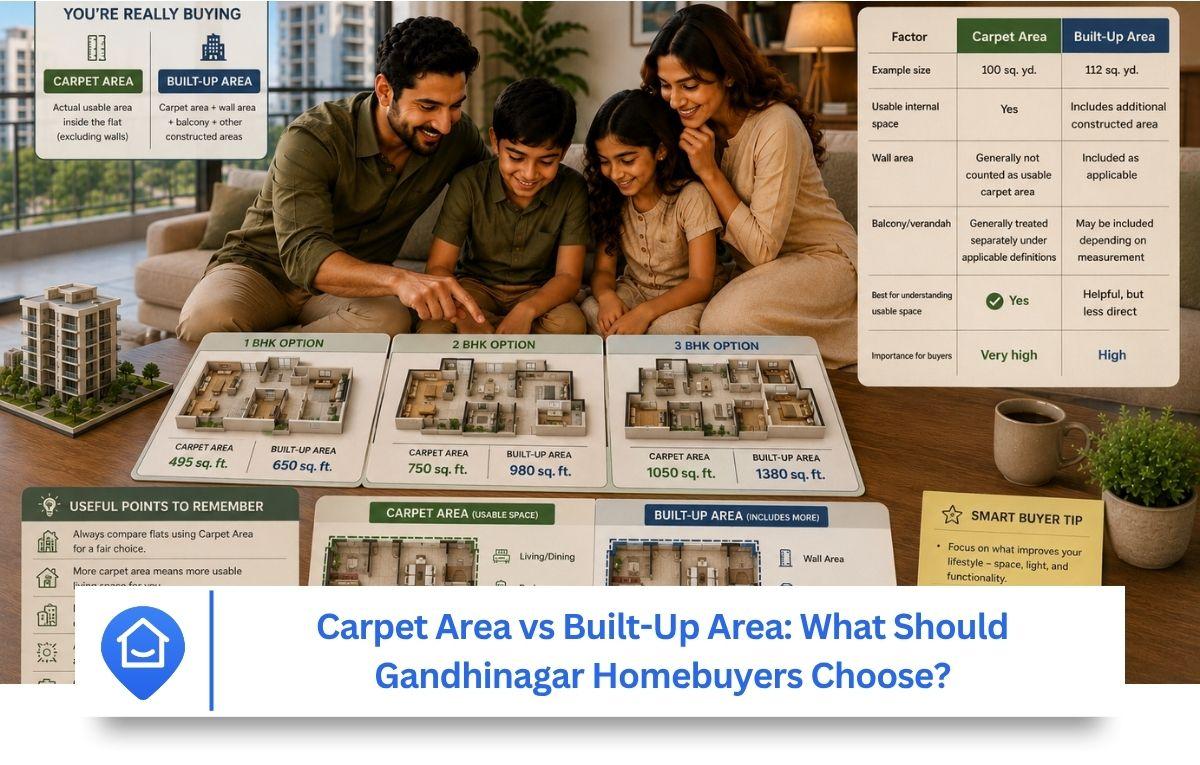
Carpet area refers to the usable floor area inside a residential unit, while built-up area generally includes the carpet area along with the area occupied by walls and certain attached areas such as balconies or verandahs, as applicable.
For most homebuyers, carpet area is the more useful measurement for understanding the actual usable space of a home.
However, carpet area alone should not determine your decision. The property's location, layout, construction quality, natural light, ventilation, amenities and total cost also matter.
What Is Carpet Area?
Carpet area is the usable floor area inside your apartment or home.
A simple way to understand it is to imagine the portion of your home where you could actually place a carpet and use the space for everyday living.
For example, suppose a flat has a carpet area of 100 sq. yd.
This means the apartment provides approximately 100 square yards of usable internal floor area according to the applicable measurement definition.
The actual documented carpet area should always be checked in the property's official documents.
What Does Carpet Area Include?
The carpet area can include usable internal spaces such as:
- Living room
- Bedrooms
- Kitchen
- Dining area
- Bathrooms
- Internal passages
- Other usable spaces within the apartment
Under RERA, carpet area has a defined legal meaning. Buyers should therefore rely on the carpet area stated in relevant official documentation rather than estimating it from the property's advertised size.
What Is Built-Up Area?
Built-up area is generally larger than carpet area because it includes the carpet area plus wall areas and certain additional areas such as balconies or verandahs, where applicable.
For example:
- Carpet Area: 100 sq. yd.
- Wall and applicable additional area: 12 sq. yd.
- Built-Up Area: approximately 112 sq. yd.
The exact calculation depends on the property's design and documentation.
This is why a home advertised as 120 sq. yd. built-up area does not necessarily provide 120 sq. yd. of usable internal living space.
Carpet Area vs Built-Up Area in Square Yards
Here's a simple comparison:
| Factor | Carpet Area | Built-Up Area |
|---|---|---|
| Example size | 100 sq. yd. | 112 sq. yd. |
| Usable internal space | Yes | Includes additional constructed area |
| Wall area | Generally not counted as usable carpet area | Included as applicable |
| Balcony/verandah | Generally treated separately under applicable definitions | May be included depending on measurement |
| Best for understanding usable space | ✅ Yes | Helpful, but less direct |
| Importance for buyers | Very high | High |
Simple Example
Imagine two flats:
Flat A
- Carpet Area: 100 sq. yd.
- Built-Up Area: 112 sq. yd.
Flat B
- Carpet Area: 105 sq. yd.
- Built-Up Area: 118 sq. yd.
Although the difference in advertised size may appear small, Flat B provides approximately 5 sq. yd. more carpet area.
That additional usable space can make a difference in room sizes, furniture placement and everyday comfort.
What Is Super Built-Up Area?
Along with carpet and built-up area, you may also come across super built-up area.
Super built-up area can include the built-up area plus a proportionate share of common areas in a project.
Depending on the project and calculation method, these may include areas associated with:
- Common corridors
- Lobby
- Staircases
- Lift areas
- Common facilities
- Other shared spaces
Therefore, the super built-up area can be considerably higher than the actual usable carpet area.
Carpet Area vs Built-Up Area vs Super Built-Up Area
Let's understand all three with a simple square-yard example.
Suppose a flat is marketed as approximately 135 sq. yd.
Its figures could look something like:
| Area Type | Example |
|---|---|
| Carpet Area | 100 sq. yd. |
| Built-Up Area | 112 sq. yd. |
| Super Built-Up Area | 135 sq. yd. |
This means you should not automatically assume that 135 sq. yd. represents the usable space inside your flat.
The exact numbers will differ from property to property.
Remember:
Carpet Area → Usable internal space
Built-Up Area → Carpet area + walls and applicable additional areas
Super Built-Up Area → Built-up area + proportionate common areas, where applicable
Why Carpet Area Matters for Gandhinagar Homebuyers
If you're searching for flats in Gandhinagar, understanding carpet area can make property comparisons much easier.
Here are some of the biggest reasons it matters.
1. It Shows How Much Space You Can Actually Use
A property advertised as 150 sq. yd. may sound spacious.
But before deciding, ask:
"Is 150 sq. yd. the carpet area, built-up area or super built-up area?"
If the 150 sq. yd. figure refers to the super built-up area, your actual usable area may be significantly lower.
2. It Makes Property Comparison Easier
Suppose you are comparing two 3 BHK flats in Gandhinagar.
Flat A
- Price: ₹80 lakh
- Carpet Area: 105 sq. yd.
- Built-Up Area: 120 sq. yd.
Flat B
- Price: ₹82 lakh
- Carpet Area: 112 sq. yd.
- Built-Up Area: 127 sq. yd.
At first glance, Flat B costs more.
However, it also provides 7 sq. yd. more carpet area.
This gives you a better basis for comparing the two properties.
How to Calculate Property Price per Square Yard
One useful way to compare properties is to calculate the approximate price per square yard based on the relevant area.
For example:
Property Price = ₹80,00,000
Carpet Area = 100 sq. yd.
Approximate price based on carpet area:
₹80,00,000 ÷ 100 = ₹80,000 per sq. yd.
Now imagine another property:
Property Price = ₹82,00,000
Carpet Area = 110 sq. yd.
₹82,00,000 ÷ 110 ≈ ₹74,545 per sq. yd.
This doesn't automatically mean the second property is the better purchase. Location, quality, floor, amenities, parking, age and other factors must also be considered.
But it provides an additional metric for comparison.
How Square Yards and Square Feet Are Related
Property listings in Gujarat may use both square yards and square feet, so knowing the conversion can be helpful.
Basic Conversion
1 square yard = 9 square feet
Therefore:
| Square Yards | Square Feet |
|---|---|
| 50 sq. yd. | 450 sq. ft. |
| 75 sq. yd. | 675 sq. ft. |
| 100 sq. yd. | 900 sq. ft. |
| 125 sq. yd. | 1,125 sq. ft. |
| 150 sq. yd. | 1,350 sq. ft. |
| 200 sq. yd. | 1,800 sq. ft. |
| 250 sq. yd. | 2,250 sq. ft. |
| 300 sq. yd. | 2,700 sq. ft. |
So, for example, a 150 sq. yd. flat is equivalent to 1,350 sq. ft.
However, the conversion between units does not change the distinction between carpet, built-up and super built-up area.
Why a Bigger Flat Does Not Always Mean a Better Flat
Imagine two apartments:
Apartment A: 140 sq. yd. advertised area Apartment B: 125 sq. yd. advertised area
You might immediately assume Apartment A is better.
But what if:
- Apartment A has 100 sq. yd. carpet area
- Apartment B has 105 sq. yd. carpet area
In this situation, Apartment B actually provides more usable internal space despite having the smaller advertised area.
This is why the number of square yards alone isn't enough to judge a property.
Carpet Area vs Built-Up Area: Which Should You Choose?
For most homebuyers, carpet area should be the first measurement to consider when comparing usable space.
However, the best property isn't necessarily the one with the largest carpet area.
You should also consider:
- Location
- Connectivity
- Floor plan
- Room dimensions
- Natural light
- Ventilation
- Balcony
- Parking
- Construction quality
- Amenities
- Developer reputation
- Maintenance costs
- Total purchase cost
- Future resale potential
For example, a well-planned 100 sq. yd. carpet-area apartment may feel more comfortable than a poorly planned 110 sq. yd. apartment.
How Gandhinagar Homebuyers Should Compare Flats
Before booking a flat, follow this simple checklist.
Step 1: Ask for the Carpet Area
Don't stop at the headline property size.
Ask:
"What is the carpet area in square yards?"
Step 2: Ask for the Built-Up Area
Understand how much additional area comes from walls and other applicable components.
Step 3: Check the Floor Plan
Don't rely only on the total square-yard figure.
Look at the actual dimensions of:
- Bedrooms
- Living room
- Kitchen
- Bathrooms
- Balcony
- Passage areas
Step 4: Check the Official Documents
Compare the figures provided by the salesperson with the property's relevant official documentation.
Step 5: Compare Price Against Carpet Area
Looking at the effective price per square yard of carpet area can provide a useful comparison between similar properties.
Step 6: Visit the Property
A floor plan gives you measurements, but an actual site visit helps you understand:
- Room proportions
- Natural lighting
- Ventilation
- Noise
- View
- Accessibility
- Overall feel of the home
What Should You Ask a Builder or Seller?
Before booking a property in Gandhinagar, ask these questions:
- What is the carpet area in sq. yd.?
- What is the built-up area in sq. yd.?
- Is the quoted size carpet, built-up or super built-up?
- What is the balcony area?
- What is included in the quoted price?
- Is parking included?
- What additional charges will apply?
- What is the project's RERA registration information, where applicable?
- Can I see the approved floor plan?
- Does the agreement mention the same area?
Getting these details before paying a booking amount can help prevent misunderstandings later.
Common Mistakes Homebuyers Make
Mistake 1: Looking Only at the Biggest Number
A property marketed as 150 sq. yd. isn't necessarily larger in usable terms than another property marketed at 135 sq. yd.
Always identify what the number represents.
Mistake 2: Comparing Different Area Measurements
Comparing one property's super built-up area with another property's carpet area doesn't give you a meaningful comparison.
Try to compare carpet area with carpet area.
Mistake 3: Ignoring the Floor Plan
Two properties with the same carpet area can feel completely different because of their layouts.
Mistake 4: Focusing Only on Price per Sq. Yd.
Price per square yard is useful, but it isn't the only factor.
A property with a lower price per sq. yd. may have disadvantages in location, construction, amenities or layout.
Mistake 5: Not Checking Documents
Always verify important property details against relevant official documents before making a purchase decision.
Carpet Area vs Built-Up Area: Quick Comparison for Buyers
| Question | What You Should Look At |
|---|---|
| How much usable space do I get? | Carpet Area |
| How large is the constructed unit? | Built-Up Area |
| Does the property include common-area loading? | Super Built-Up Area |
| How should I compare similar flats? | Carpet Area |
| How should I check room sizes? | Floor Plan |
| How should I evaluate price? | Total cost + carpet area |
| What should I verify before booking? | Official documents |
FAQs: Carpet Area vs Built-Up Area
1. What is carpet area in square yards?
Carpet area in square yards represents the usable floor area of a residential unit, expressed in sq. yd. For example, a carpet area of 100 sq. yd. represents approximately 900 sq. ft. of area because 1 sq. yd. equals 9 sq. ft.
2. What is built-up area in square yards?
Built-up area is generally the carpet area plus the area occupied by walls and certain additional areas such as balconies or verandahs, depending on the applicable measurement and property documentation.
3. Should I buy a property based on carpet area?
Carpet area is one of the most useful measurements for understanding usable space, but you should also evaluate location, layout, construction quality, amenities, total cost and your family's requirements.
4. Which is better for comparing flats: carpet area or built-up area?
Carpet area is generally more useful for comparing the actual usable space of similar flats. Compare carpet area with carpet area rather than comparing one property's carpet area with another property's super built-up area.
5. Does carpet area include walls?
Under the RERA definition, carpet area includes the area covered by internal partition walls but excludes external walls and certain other areas. Buyers should verify the exact documented measurement for the specific property.
6. Why is carpet area smaller than built-up area?
Built-up area generally includes the carpet area plus wall areas and certain additional components. Therefore, built-up area is normally larger than carpet area.
Final Takeaway
Understanding carpet area vs built-up area can save Gandhinagar homebuyers from one of the most common property-buying mistakes: assuming that the largest advertised number represents the actual usable space.
When comparing flats in Gandhinagar, start with the carpet area in square yards, then look at the floor plan, room dimensions, location, construction quality, amenities and complete purchase cost.
For example, don't simply compare a 150 sq. yd. property with a 130 sq. yd. property. First determine whether those figures represent carpet area, built-up area or super built-up area.
The right home isn't necessarily the one with the biggest number of square yards. It's the one that gives you the right combination of usable space, layout, location, quality and value for your budget.
Looking for property in Gandhinagar? Explore suitable residential properties, compare their actual sizes and make your next property decision with greater confidence.