
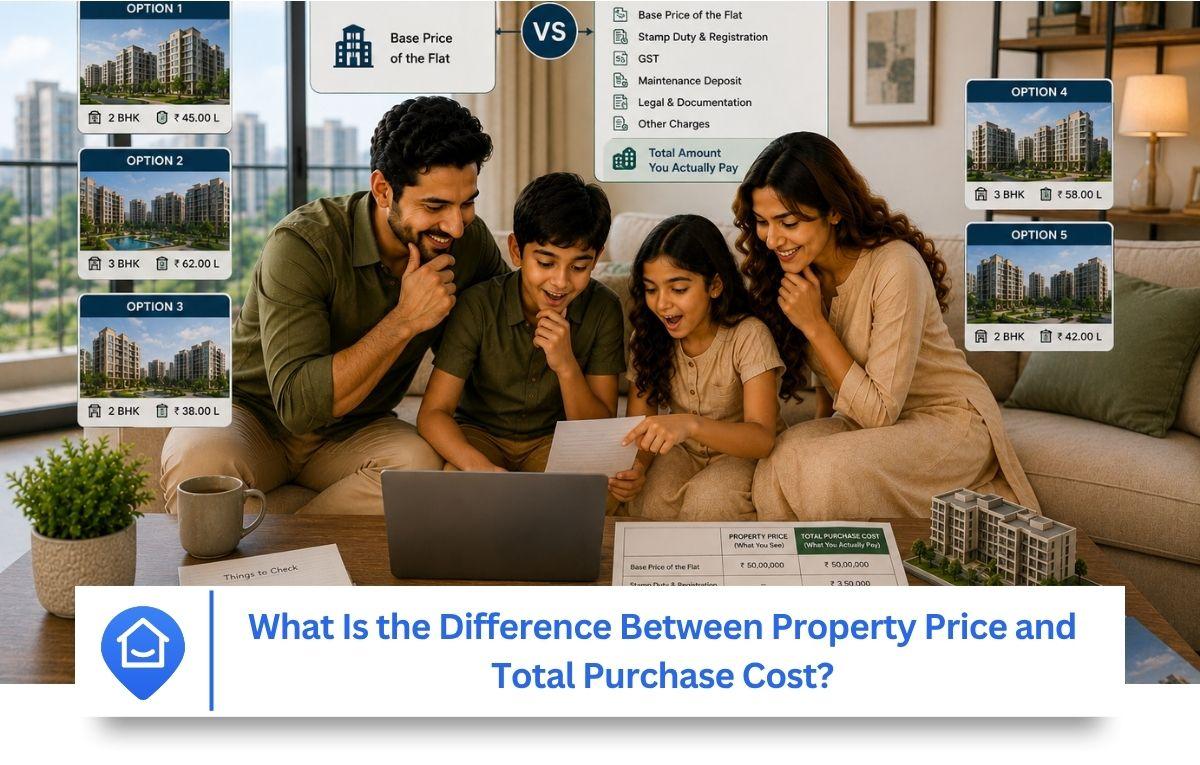
When buying a home, many buyers focus on one number: the property price. For example, if a flat in Gandhinagar is advertised at ₹60 lakh, it is easy to assume that ₹60 lakh is the amount you need to arrange.
However, the actual amount required to complete the purchase can be higher.
This is because property price and total purchase cost are not the same. Apart from the property's quoted or negotiated price, buyers may need to account for government charges, taxes where applicable, registration expenses, brokerage, legal documentation and other transaction-related costs.
Understanding these expenses before finalizing a property can help you set a realistic budget and avoid unexpected financial pressure.
Property Price vs Total Purchase Cost: What Is the Difference?
The simplest way to understand the difference is:
Property price is the amount agreed for the property itself, while total purchase cost is the property price plus all applicable expenses involved in completing the purchase.
For example, suppose you are purchasing a flat for ₹60 lakh.
Your property price may be ₹60 lakh, but your total purchase cost could be higher after adding applicable stamp duty, registration charges, brokerage, legal fees and other expenses.
The exact additional amount varies depending on the property, transaction structure, location, applicable government rules and services used.
What Is Property Price?
Property price is the agreed selling price of the property between the buyer and seller or the price offered by the developer.
It may refer to the price of:
- A residential flat
- An apartment
- A villa
- A bungalow
- A plot
- A commercial property
- An office
- A retail space
For instance, if a 3 BHK flat in Gandhinagar is listed for ₹75 lakh and you negotiate and agree to purchase it for ₹72 lakh, ₹72 lakh becomes the agreed property price.
However, buyers should always ask whether the quoted price includes all components or whether certain charges are separate.
What Is Total Purchase Cost?
Total purchase cost is the broader amount you should budget for to complete the property purchase.
It can include:
- Property price
- Stamp duty
- Registration charges
- GST, where applicable
- Brokerage
- Legal and documentation expenses
- Loan-related charges
- Maintenance or society-related charges, where applicable
- Other applicable transaction or property-specific charges
Not every property will have every charge. For example, GST treatment can differ depending on the type and stage of the property transaction.
Therefore, buyers should ask for a detailed cost sheet before making a financial commitment.
Property Price vs Total Purchase Cost: Quick Comparison
| Cost | Property Price | Total Purchase Cost |
|---|---|---|
| Property's agreed price | ✓ | ✓ |
| Stamp duty | ✗ | ✓ |
| Registration charges | ✗ | ✓ |
| Applicable GST | ✗ | ✓ |
| Brokerage | Usually separate | ✓, if applicable |
| Legal/documentation fees | Usually separate | ✓, if applicable |
| Loan-related expenses | ✗ | May apply |
| Other applicable charges | ✗ | ✓ |
The important takeaway is that the advertised property price should not automatically be treated as your final purchase budget.
Major Expenses to Consider When Buying Property
1. Stamp Duty
Stamp duty is a government charge associated with certain property transactions. The applicable rate and calculation can depend on the state, transaction and property circumstances.
For buyers in Gujarat, it is important to check the latest applicable rules and rates before calculating the final purchase budget.
2. Registration Charges
Property registration is another important expense.
Registration formally records the transaction with the relevant government authority. The applicable registration charges should therefore be included when calculating your overall buying budget.
3. GST, Where Applicable
GST may apply to certain property transactions, particularly specific under-construction property purchases, subject to applicable rules and exemptions.
For example, GST treatment can differ between an under-construction property and a completed property.
Because tax treatment can change depending on the transaction, buyers should confirm the applicable GST position with the developer or a qualified tax professional before making a decision.
4. Brokerage
If you use a real estate broker or consultant to find and complete a property transaction, brokerage may be applicable.
The amount can depend on the agreement between the buyer, seller and broker.
Before proceeding, clarify:
- Who is paying the brokerage?
- What is the brokerage amount?
- Is GST applicable?
- When is the payment due?
Getting these details in writing can prevent confusion later.
5. Legal and Documentation Expenses
Property transactions involve important documents and legal checks.
Depending on the transaction, buyers may spend money on:
- Legal consultation
- Document verification
- Agreement preparation
- Title-related checks
- Other documentation services
These expenses may be relatively small compared with the property price, but they should still be included in your overall budget.
6. Home Loan-Related Expenses
If you are financing the purchase through a home loan, additional expenses may arise.
Depending on the lender and loan, these can include:
- Processing fees
- Valuation charges
- Documentation charges
- Other applicable loan-related fees
Remember that the loan amount is not the same as your total property budget. You also need to plan for your down payment and other purchase expenses.
Example: How Total Purchase Cost Can Be Higher Than Property Price
Imagine you are buying a residential property in Gandhinagar with an agreed property price of ₹60 lakh.
Your calculation should not stop at:
Property price = ₹60 lakh
Instead, create a broader budget:
Property price + applicable government charges + taxes + brokerage + legal/documentation costs + other applicable expenses = Total purchase cost
The exact amount of each component should be confirmed before purchase because charges and tax treatment can vary.
This approach gives you a much more realistic understanding of how much money you need to complete the transaction.
Why Buyers Should Calculate Total Cost Before Buying
One of the most common mistakes first-time buyers make is calculating affordability based only on the property's advertised price.
For example, a buyer may decide that a ₹70 lakh property is affordable because they have planned their down payment and loan around ₹70 lakh.
But if additional purchase expenses are not included in the financial plan, the buyer may need additional funds at the time of registration or closing.
Calculating the total cost beforehand helps you:
- Set a realistic property budget
- Plan your down payment
- Estimate your loan requirement
- Maintain an emergency fund
- Compare properties more accurately
- Avoid last-minute financial stress
How to Calculate Your Property Buying Budget
Before visiting properties, follow these simple steps:
Step 1: Decide Your Maximum Property Price
Determine how much you can comfortably spend on the property itself.
Step 2: Add Government Charges
Include applicable stamp duty and registration charges.
Step 3: Check Tax Applicability
Ask whether GST or any other applicable tax needs to be paid.
Step 4: Add Service Costs
Consider brokerage, legal consultation, documentation and loan-related expenses.
Step 5: Keep a Financial Buffer
Don't use every rupee of your available savings for the purchase. Maintaining an emergency reserve can make homeownership financially safer.
Property Price Is Not Always the Final Number
When comparing two properties, buyers should avoid looking only at the headline price.
For example:
Property A: ₹65 lakh Property B: ₹68 lakh
At first glance, Property A appears cheaper.
However, if the two properties have different included features, charges, taxes, maintenance requirements or transaction expenses, the final financial comparison may be different.
That's why comparing the overall purchase cost and value is more useful than comparing only the advertised price.
Questions to Ask Before Finalizing a Property
Before paying a token amount or signing an agreement, ask the seller or developer for a detailed cost breakdown.
You can ask:
- What is the final negotiated property price?
- Which charges are included?
- Are stamp duty and registration included?
- Is GST applicable?
- Is brokerage payable?
- Are maintenance or society charges separate?
- Are there any additional documentation or administrative charges?
- What amount needs to be paid at each stage?
- What are the loan-related costs?
A written cost sheet can help you understand the financial commitment clearly.
FAQs
1. Is property price the same as the total purchase cost?
No. Property price refers to the agreed price of the property, while total purchase cost includes the property price plus applicable taxes, government charges, brokerage, legal expenses and other transaction-related costs.
2. What additional costs should I consider when buying a property?
Common additional costs can include stamp duty, registration charges, applicable GST, brokerage, legal/documentation expenses and home-loan-related charges.
3. Does GST apply to every property purchase?
No. GST applicability depends on factors such as the type and stage of the property transaction. Buyers should confirm the applicable tax treatment before purchasing.
4. Should I budget only for the property's advertised price?
No. It is better to calculate the estimated total purchase cost before deciding whether a property fits your budget.
5. How can I avoid unexpected property purchase expenses?
Ask the seller or developer for a complete cost sheet and verify applicable government charges, taxes, brokerage and other expenses before making a financial commitment.
Final Takeaway
Understanding property price vs total purchase cost is essential for making a financially informed property decision. The advertised price tells you what the property itself costs, but your actual financial commitment can include several additional expenses.
Whether you're looking for a flat, villa, plot or commercial property in Gandhinagar, always calculate the complete purchase cost before finalizing your budget.
At PropertyFlick, you can explore property options in Gandhinagar and compare properties based on your requirements and budget. Before making a decision, get a clear understanding of the property's price, applicable charges and overall buying expenses so there are no surprises later.